INDIAN RAILWAYS · LOCAL CRAFTS
ONE STATION ONE PRODUCT
Turning Gujarat’s craft diversity into a station-ready product strategy
172
Products mapped
50+
Passengers + vendors

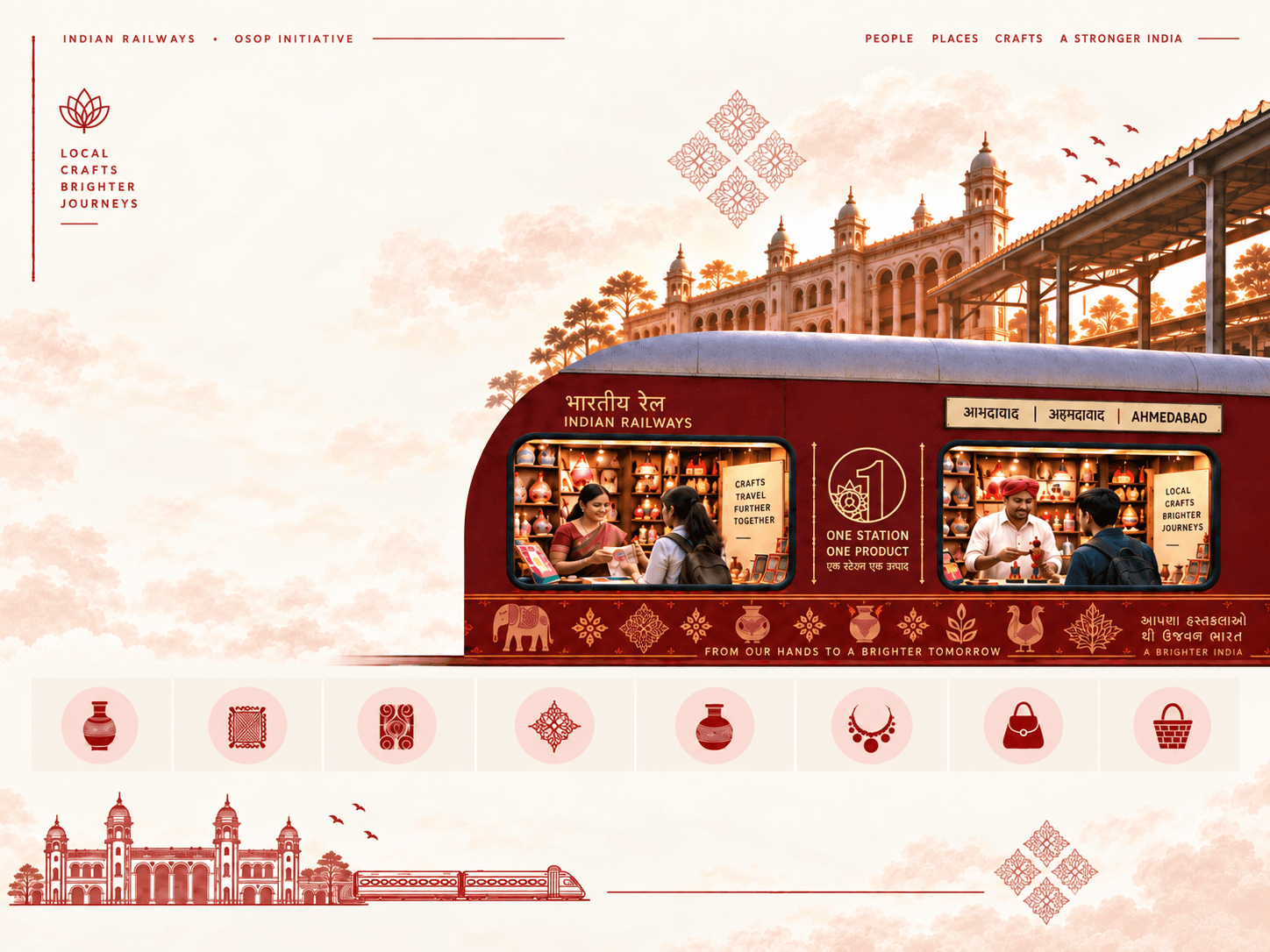
EXAMPLES OF GUJARAT CRAFTS
Pottery
Textiles
Woodcraft
Embroidery
Metalwork
Jewellery
Leather
Basketry
Ahmedabad Station
Field study lead
9-person NID team
4 weeks

For Indian Railways’ OSOP initiative, our team mapped 172 products and studied passenger and vendor behaviour at Ahmedabad Station to understand what could realistically work in this retail context.


02. THE MANDATE

Promote regional products
Products rooted in the station’s region

Create market access
For local artisans and producers

Represent regional craft
Showcase local craft and cultural identity

Use passenger footfall
Improve product visibility
From regional crafts to national opportunities
One Station One Product (OSOP) is an Indian Railways initiative that creates market access for regional products through railway stations, supporting local artisans and small producers while showcasing local craft traditions.

Field research with passengers at Ahmedabad Railway Station
For Ahmedabad Station, the challenge was to determine which Gujarat crafts could realistically succeed in this environment, considering passenger needs, commercial viability and station context.

The mandate set the ambition; the research had to decide which crafts could earn a place on the platform.
03. THE RESEARCH QUESTION
The brief defined the opportunity, but not which crafts were right for Ahmedabad Station
Gujarat offered a vast and diverse craft landscape. To recommend a viable product mix, we needed to understand both what could work as a product and what passengers would actually notice, value and consider buying within the realities of railway travel.

Craft + Product Fit
IS IT THE RIGHT PRODUCT FROM A CRAFT PERSPECTIVE?
Utility
Product type
Price band
Durability / Fragility
Craft capability
Regional relevance
Sustainability
Everyday use, not just decorative
Standardised, consistent quality
Viable for artisans and passengers
Skills and production capacity
Authentic to Gujarat’s craft heritage
Responsible, long-lasting materials
Can it withstand handling and travel?


Passenger + Station Fit
DOES IT WORK FOR THE PASSENGER AND STATION CONTEXT?
Passenger preferences
Perceived value
Price sensitivity
Luggage compatibility
Time pressure
Visibility
Travel context
Appeals to varied ages and travellers
Meaningful, authentic, worth buying
Fits impulse and planned budgets
Works well in station retail
Suits personal use or gifting
Easy to carry, pack and transport
Quick to browse, easy to choose


The right product mix had to work for both the craft and the journey.


04. RESEARCH APPROACH
We studied the decision from three connected perspectives
We combined craft research, passenger behaviour and station observations so the final direction would reflect product realities, human behaviour and the constraints of the environment.
01. CRAFT LANDSCAPE
What is available?
Mapping Gujarat’s craft breadth, categories, materials, price points and product characteristics.
02. PASSENGER BEHAVIOUR
What do travellers consider buying?
Studying preferences, perceived value, purchase purpose and what passengers considered in context.
03. STATION CONTEXT
What changes in a railway environment?
Observing movement, luggage, time pressure, visibility and platform conditions.
METHODS

Survey

Interviews

Contextual inquiry

Observation
4
methods across one station over four weeks of field research
No single lens chose the products: each perspective tested what the other two could miss.


EVIDENCE-LED DIRECTION
Insights from all three perspectives informed the product selection logic.


05. THE CRAFT LANDSCAPE
172 products created a selection problem, not a shortage of options
We mapped craft products across five categories to understand the available landscape. The range showed Gujarat’s breadth, but cultural relevance alone could not determine what belonged in a railway-station retail environment.
FROM LANDSCAPE TO SELECTION
Which products could work for both the craft and the journey?

12
CRAFT TOYS
Wooden, textile and traditional play objects rooted in local craft traditions.
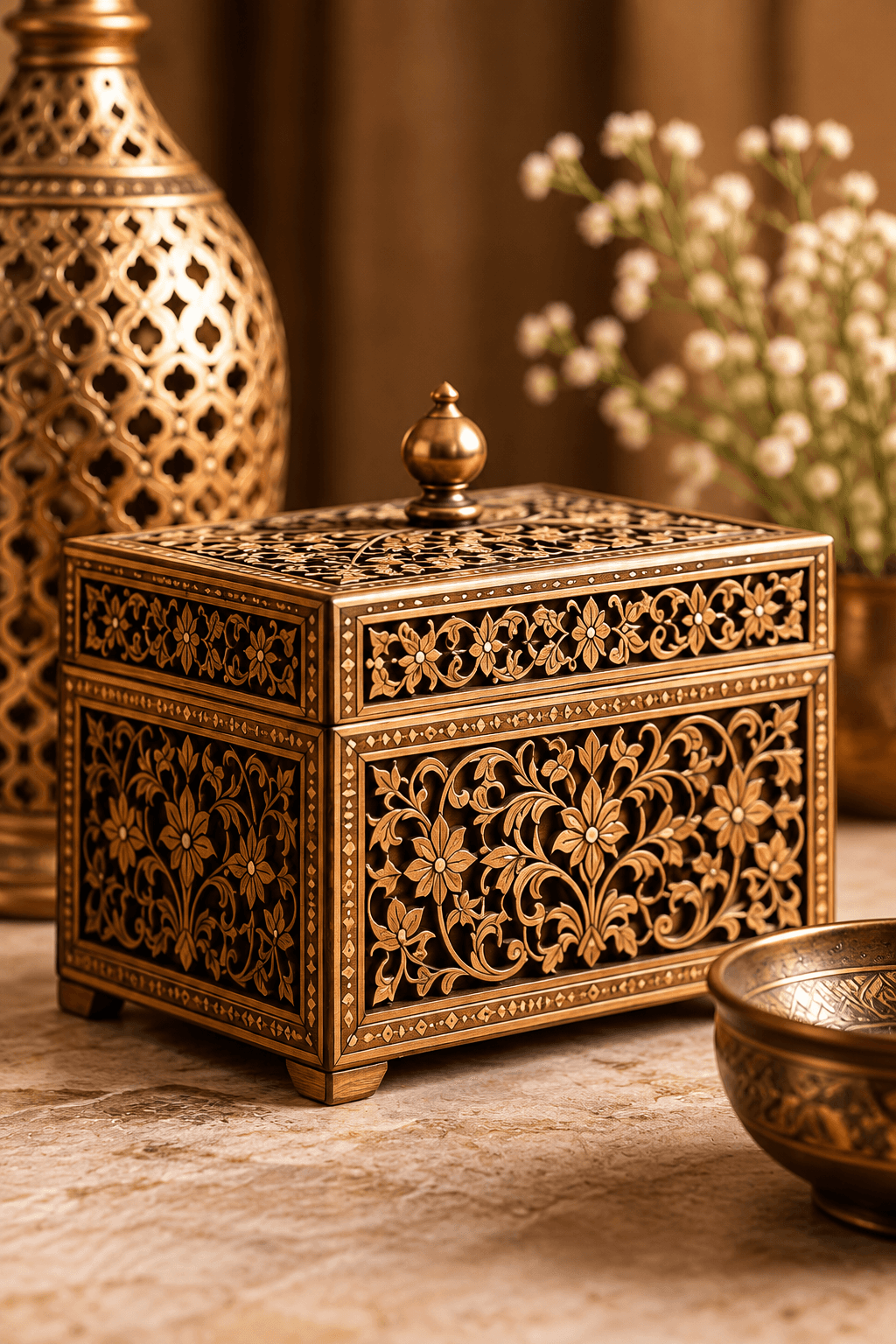
36
DÉCOR
Artisan objects for display, home and gifting.

77
ACCESSORIES
Jewellery, bags and smaller personal items with regional character.

32
GARMENTS + TEXTILES
Apparel, stoles, dupattas and fabric-based products showcasing local weave and print traditions.

15
UTILITY
Everyday objects such as serveware, organizers and other functional craft products.
The 172 products were a starting pool, not a proposed station assortment.
06. FROM RELEVANCE TO SUITABILITY
A culturally relevant craft was not automatically suitable for railway-station retail
Clustering craft items by packaging size and price.


Craft Toys
12 items
Accessories
77 items
Décor
36 items
Garments + Textiles
32 items
Utility
15 items
We compared the mapped items on practical factors: packaging size, price band, portability, product category, suitability for travel, and how quickly a passenger could consider and buy them.
This separated products that simply represented Gujarat from products that could also work within the physical and behavioural constraints of railway travel.
HOW TO READ THIS CHART
Each block is one mapped product, stacked in the column for its category.
Colour shows the price band: light blush for ₹0–500, dusty rose for ₹501–2,000 and brick for ₹2,001–5,000.
Block size shows packaging size: small up to 6″, medium up to 12″ and large above 12″.
Legend
Price
₹ 0-500
₹ 501-2000
₹ 2001-5000
Size
Small
Medium
6"X6"X6"
12"X12"X12"
>12"x12"x12"
Size and price exposed the trade-off: many culturally rich products were poorly suited to how passengers actually move through a station.
Large
07. PASSENGER REALITY
On the platform, craft purchases had to compete with luggage, intent and visibility.
Station interviews and observations showed where the broad product opportunity met the practical limits of a railway journey.


Field interviews and platform observations · Ahmedabad Railway Station
3
platform frictions that reshaped the product brief
Three frictions that changed the product brief
01
02
03
Movement + luggage
Time + purchase intent
Visibility + platform access
• Passengers carrying several bags rarely stopped to explore.
• Some passing-through passengers were more open to a station purchase.
• Platforms near the entry saw more footfall.
• Those with multiple trolleys hesitated over large or heavy craft items.
• Arriving visitors expected wider craft choice in city markets.
• Few craft or utility carts were visible across platforms.
Decision
Prioritise compact, lightweight products.
Decision
Make the offer quick to understand and buy.
Decision
Treat placement as part of the product strategy.
PASSENGER VOICE
“I would opt to buy craft from a railway station only if I am just passing by this station, but if I am visiting, market would have better variety of products to select from.”
— Passenger interview
On the platform, a suitable product still needed the right moment: in sight, within reach and quick to decide on.
08. WHAT SHAPED VALUE
Passengers valued craft when it felt useful, fairly priced and distinctive
Preference alone was not enough to drive a purchase. Passengers weighed practical usefulness, price and perceived quality alongside uniqueness, authenticity and regional meaning.


Functional value
Usefulness · portability · durability

Economic value
Price · perceived quality

Emotional + cultural value
Uniqueness · authenticity · regional story

What travellers said they would buy
Famous food items
Local textiles, sarees and shawls
Local craft items
61%
52%
47%
64%
wanted souvenirs or gifts for family and loved ones
Gift preference
36%
Accessories
35%
Textiles
32%
Traditional embroidery
In the 50+ participant sample, men aged 20–40 leaned more toward food, sarees and embroidery, while women aged 20–40 showed stronger interest in craft accessories.
Gifting was the strongest motive, so the offer had to feel worth giving, not just worth owning.
09. RESEARCH SYNTHESIS
Five insights turned passenger behaviour into product and communication decisions
Across preference, travel behaviour and station observations, five signals consistently changed what we would select, how we would package it and how its value should be communicated.
THE FIVE SIGNALS
01
Research signal
Compact wins

WHAT WE LEARNED
WHAT IT CHANGED
Passengers carrying luggage were less likely to consider bulky or fragile products.
We prioritised compact, lightweight and easy-to-carry items for the core mix.
02
Research signal
Utility matters

WHAT WE LEARNED
WHAT IT CHANGED
Passengers responded more positively when craft felt useful, not only decorative.
We favoured useful crafts whose distinctiveness was clear at a glance.
03
Research signal
Price reduces friction

WHAT WE LEARNED
WHAT IT CHANGED
Products below ₹500 were easier to consider within short station dwell times, especially when browsing was quick.
We recommended an accessible entry price band and prioritised travel-ready products over premium-only craft.
04
Research signal
Visibility drives discovery

WHAT WE LEARNED
WHAT IT CHANGED
Platform location, footfall and retail visibility shaped whether products were noticed at all.
Placement and discoverability became part of the product strategy, not an execution detail.
05
Research signal
Authenticity builds trust

WHAT WE LEARNED
WHAT IT CHANGED
Passengers wanted reassurance that products were genuinely connected to the craft, region and maker.
We recommended concise origin, artisan and authenticity cues at the point of sale.
Research narrowed the opportunity from “what people liked” to “what could realistically work.”
10. SELECTION LOGIC
Research became a practical framework for deciding what to introduce first
We assessed candidate crafts across product fit, passenger fit and station context, rather than popularity alone.

Balanced,
context-aware
selection

Research-informed selection criteria
Selection logic
How the criteria were applied

STEP 01
Shape the initial product mix
Use all three lenses together.

STEP 02
Prioritise what to introduce first
Balance appeal, portability and fit.

STEP 03
Test high-preference crafts early
Treat preference as one signal.

STEP 04
Include multiple price points
Entry and higher-value price points.

STEP 05
Refine through passenger response
Validate and evolve the initial mix.

Preference signals that informed prioritisation
Survey responses highlighted several crafts that attracted strong interest. These were key candidates for the initial product mix, evaluated alongside product fit and station context.
MOST PREFERRED IN SURVEY
PREFERRED
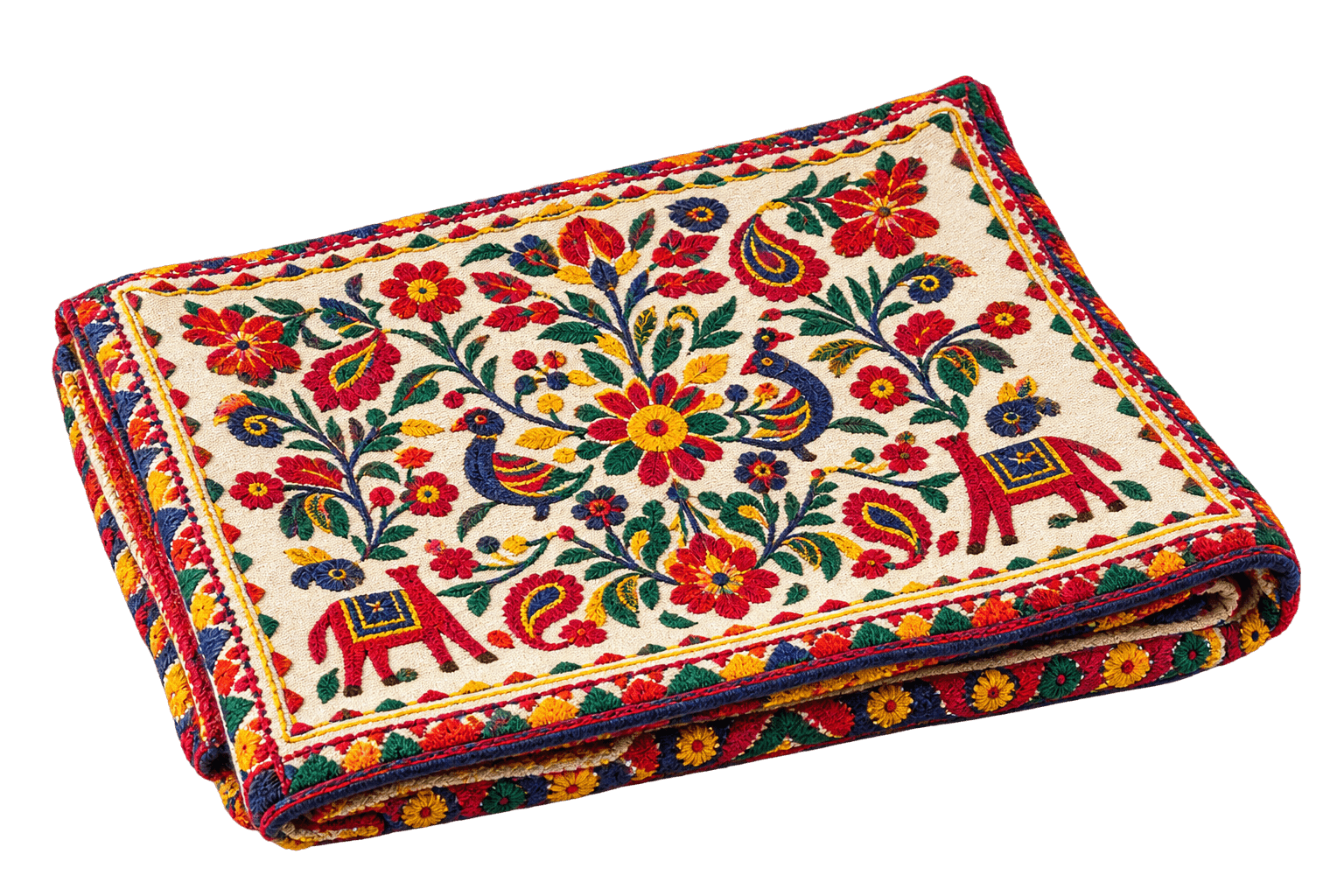
Chakla
Ari embroidery · Decorative wall piece

Toran
Ari embroidery · Door hanging

Thigda Dhingla
Traditional craft toy

Mata Ni Pachhedi
Temple cloth painting
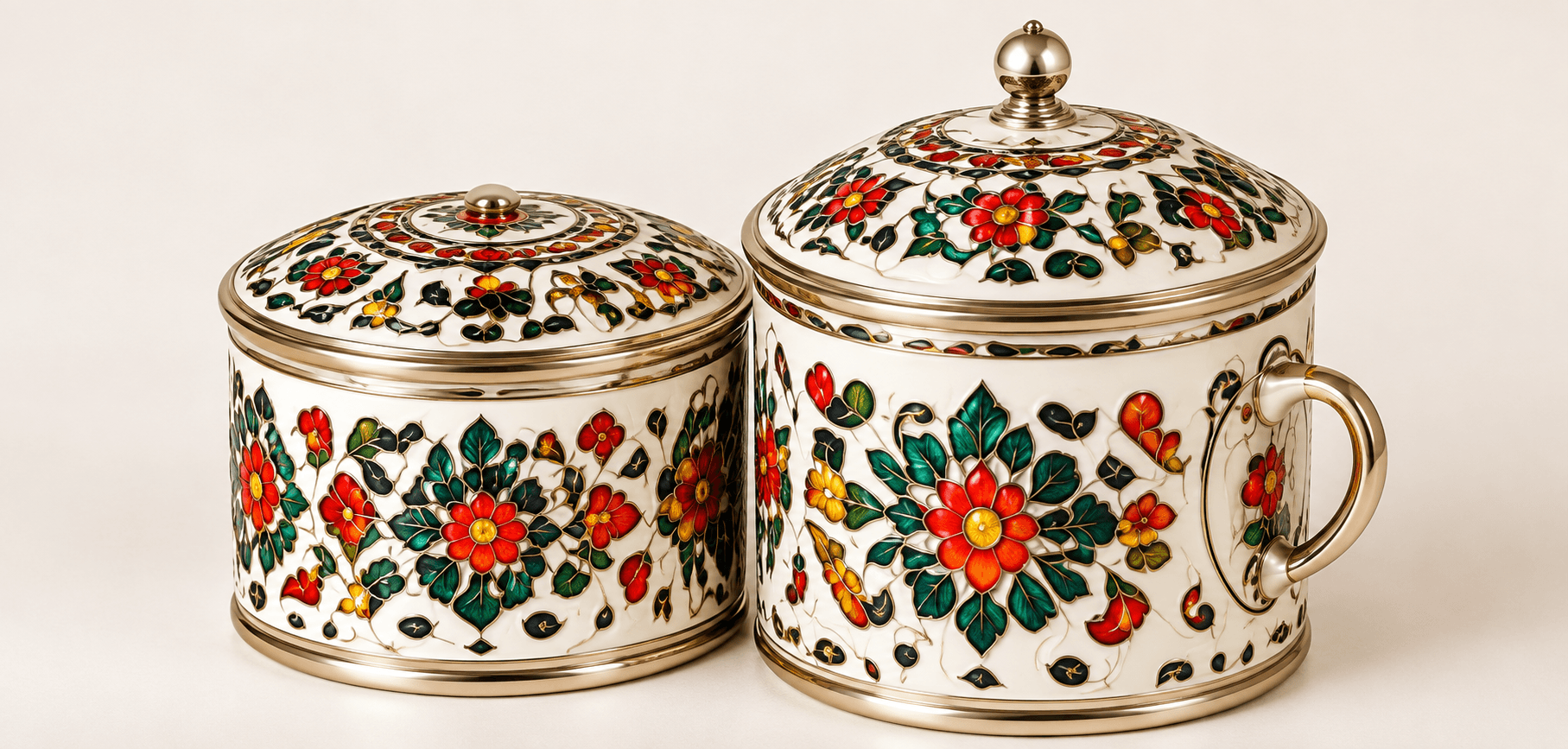
White metal / Meenakari
Decorative sculpture

Melodic bells / Bell making
Copper bells
KEY TAKEAWAY
The product direction became a testable starting hypothesis — shaped by passenger preference, product fit and railway context.
These were preference signals, not a final ranked assortment. The initial mix was intended to be refined through real passenger response.

Product fit
Could it work as a station product?
Quality perception · Packaging size · Portability · Utility

Passenger fit
Would passengers consider buying it?
Preferences · Price band · Gifting · Uniqueness

Context fit
Did it belong here?
Regional relevance · Station suitability
11. THE Strategic REFRAME
Selecting the right products solved only half the problem
Research showed that even a suitable product could fail if passengers could not quickly recognise its relevance, understand its value or trust its authenticity.

PRODUCT DECISION
Which crafts should the station actually offer?
Preference · Portability · Price · Regional relevance · Station suitability
Build a compact, travel-ready assortment grounded in passenger preference and station realities.

COMMUNICATION DECISION
How would passengers recognise, understand and value them?
Visibility · Origin · Artisan story · Authenticity
Make cultural value easy to recognise, understand and trust at a glance.

AND
The strategy had to solve both product fit and perceived value.
12. STRATEGIC DIRECTIONS
01
02
03
04
From selection to experience
The strategy moved beyond deciding which products to offer. It also addressed how products should be surfaced, understood, valued and evolved within the railway-station environment.
ARTISAN & PRODUCT STORYTELLING
Make the human story behind the craft visible
Use short artisan, origin and process stories to build authenticity, cultural meaning and perceived value without slowing down browsing.
Research signal
Cultural context was often not self-evident from the product.
Strategic direction
Use concise artisan, origin and process stories at the point of sale to make cultural value visible.
Future opportunity

BRANDING & COMMUNICATION
Make the craft easy to recognise and understand
Use a unified identity, concise product information and clear origin cues so passengers can quickly understand what a product is and why it is distinctive.
Research signal
Visibility and authenticity shaped whether products were noticed and trusted.
Strategic direction
Create a consistent visual identity across carts, signage and product information.
PRODUCT PLACEMENT & INITIAL RANGE
Launch with a focused, travel-ready assortment
Prioritise compact, portable and accessible products across preferred categories and price points, then refine the range through passenger response.
Research signal
Passengers preferred products that were easy to carry, visibly distinctive and affordably priced.
Strategic direction
Start with a curated mix across preferred categories and price points, designed for quick browsing, carrying and gifting.
ARTISAN–DESIGNER COLLABORATION
Explore contemporary interpretations of traditional craft
Develop new applications of familiar craft techniques with designers, while preserving each craft’s identity.
Research signal
Usefulness and distinctiveness shaped preference, creating an opportunity to explore contemporary applications of traditional craft.
Strategic direction
Explore artisan–designer collaborations for contemporary, travel-relevant pieces that keep the craft’s identity.
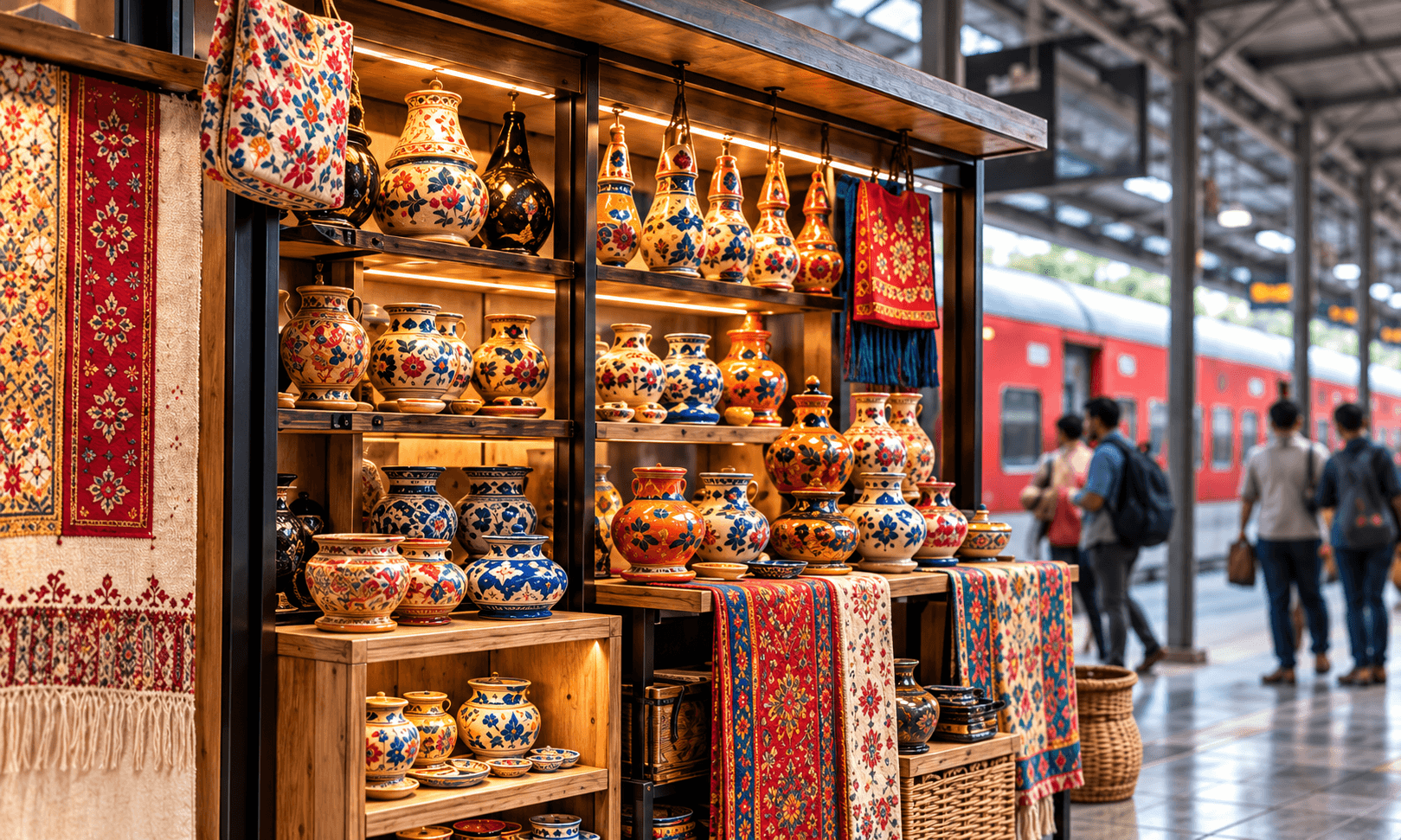
Conceptual visualisation of a station retail display.
Each direction answered a research signal, turning findings into actions a station team could run.
01
02
03
HANDED OFF
Research was translated into a product and communication direction for OSOP.
Craft landscape + categorisation
Passenger + station synthesis
Product-selection logic
Product + communication strategy

Cart design + fabrication
Signage + communication
Placement + merchandising
Operational rollout
Documented presentation of the strategic direction to Ministry stakeholders.
CONTRIBUTION BOUNDARY

The direction was developed collaboratively with the team.
I led the field study and contributed to research synthesis, craft categorisation, selection logic and the final strategic direction.
MY CONTRIBUTION
LATER EXECUTION — NOT MY WORK
Cart design, signage, merchandising and implementation were developed in a subsequent NID phase.

STRATEGY DEVELOPED
13. PRESENTATION AND HANDOFF
The strategic direction moved from research to presentation and handoff
The proposed OSOP direction was presented to the Ministry of Railways, and later taken forward by NID for execution.
MINISTRY PRESENTATION
The proposed direction was presented to the Ministry of Railways.
The direction informed the subsequent NID execution phase.
Presenting to the Ministry turned a research recommendation into a brief for the next phase of work.
14. REFLECTION
What this project taught me about turning research into product strategy
01
02
03
Cultural relevance is necessary, not sufficient
A product can belong to a region and still be wrong for the context in which it is sold.
Passenger behaviour, portability, price and operational realities ultimately determine whether cultural relevance can translate into a viable offer.
Stated preference needs behavioural context
What people say they like is only one signal.
The stronger decisions came from reading preference alongside luggage, time pressure, purchase intent and how passengers actually moved through the station.
Research becomes strategic when it changes decisions
The value of the research was not the number of insights produced.
It was turning those insights into criteria for product selection, placement, communication and storytelling.
OVERALL REFLECTION
The project strengthened my ability to connect cultural context, user behaviour, product characteristics and system constraints into a coherent strategic direction.
WHAT I WOULD DO DIFFERENTLY
I would test the initial product mix earlier through a live station pilot, so pricing, placement and communication could be validated in context rather than inferred mainly from research.
What's next


Scan+
One scan, multiple destinations, zero repetition: an enterprise scanning workflow redesigned for HP printers.
View case study


Intent First
Organising print and scan around what people want to do, not which app they open.
View case study
← Back to all work
Connect
Have a complex product problem worth untangling?
© Bhawna Tak · Strategic Product Designer
Bengaluru, India
2026